Exploring Feminism and Traditional Values
Hello readers! Conversations about women’s roles, family structures, and personal choices are a heated topic right now, with social media amplifying the most extreme voices on both sides.
Let’s take a deeper look at each side.
What is Feminism?
Feminism is defined as the belief in social, economic, and political equality of the sexes.
First Wave (mid-19th to early 20th century) Concentrated on securing legal rights and women’s suffrage. The movement organized conventions, lobbied for voting rights, and achieved success with the passage of the Nineteenth Amendment in 1920.
Second Wave (1960s-1980s) Addressed employment discrimination, wage inequality, reproductive rights, and domestic violence. The movement created women’s studies programs, overturned protective labor laws, and worked to pass the Equal Pay Act and amendments to the Civil Rights Act that included sex-based discrimination.
Third Wave (mid-1990s-early 2010s) The movement questioned binary gender concepts, incorporated postmodernist theory, emphasized individual expression and identity construction, and utilized internet platforms for communication and organizing alongside traditional institutions.
Fourth Wave (2012-present) Characterized by the use of social media platforms to address sexual harassment, assault, and abuse of power. The movement mobilized around hashtag campaigns like #MeToo, organized mass demonstrations such as the Women’s March, and focused on holding individuals and institutions accountable through public testimony and collective action online.
Read the full history of feminism
What are Traditional Values?
Traditional values refer to the moral and social standards that were widely embraced in America from its founding through much of its history. These values were largely rooted in Judeo-Christian principles and included faith in God, prayer, and Biblical teachings. Key elements included strong family structures with both fathers and mothers, marriage before sex or children, respect for authority, hard work ethics, and personal responsibility for providing for one’s family.
The “Trad Wife”: A traditional wife is a modern woman who chooses to be a full-time housewife, embracing domestic responsibilities and traditional gender roles within marriage. This lifestyle involves managing the home, raising children, and supporting her husband as the primary breadwinner. They measure their worth through family contributions, homemaking skills, and creating a loving household. The lifestyle emphasizes femininity, family-first priorities, community involvement, and traditional household skills like cooking and budgeting.
Painting Two Pictures
When the loudest voices come from the extremes, they create distorted caricatures that don’t represent the majority in either movement.
Traditional Extremes
The extreme portrayal of traditional values suggests women should abandon their autonomy entirely, submitting to their husbands’ authority because women’s opinions hold less value. In this view, traditional values become a justification for rolling back women’s rights and returning to an era of limited choices.
Graeme Reid says, “Traditional values are often deployed as an excuse to undermine human rights.”
Feminist Extremes
The extreme portrayal of feminism paints the movement as anti-male and anti-motherhood. In this view, feminists believe that women who choose to stay home and raise children are failures, less valuable than women who pursue careers. The movement becomes about tearing down men rather than lifting up women.
When you only encounter a small section of a movement, it’s easy to assume those characteristics represent the whole. There’s a parable that illustrates this perfectly.
The Blind Men and the Elephant
There were once six blind men who stood by the roadside every day. They had often heard of elephants, but they had never seen one.
One morning, an elephant was driven down the road where they stood…they asked the driver to let him stop so that they might see him.
The first one happened to put his hand on the elephant’s side. “Now I know all about this beast. He is exactly like a wall.”
The second felt only the elephant’s tusk. “My brother,” he said, “you are mistaken. He is not at all like a wall. He is round and smooth and sharp. He is more like a spear than anything else.”
The third happened to take hold of the elephant’s trunk. “Both of you are wrong,” he said. “Anybody who knows anything can see that this elephant is like a snake.”
…
Then the elephant moved on, and the six blind men sat by the roadside all day, and quarreled about him. Each believed that he knew just how the animal looked, and each called the others hard names because they did not agree with him.
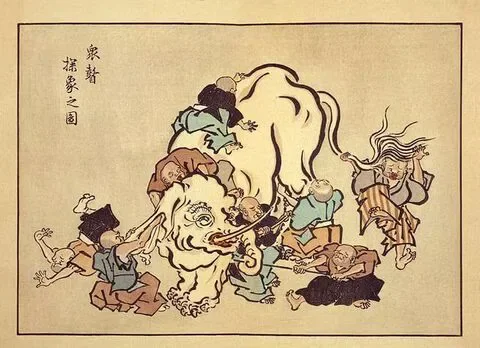
The Blind Men and the Elephant is a parable from India
What the Blind Men Missed
While the extremes are the loudest, most people hold more balanced views.
How Feminism Views Itself
At its core, feminism advocates for women’s autonomy. The right to make decisions about their own lives, careers, and futures without needing male permission or approval. Feminists argue that creating equal access to education, leadership positions, and economic independence doesn’t just benefit individual women; it benefits society as a whole.
How Traditional Values View Itself
Those who embrace traditional family structures view motherhood as purposeful, skilled work that shapes the next generation. They find fulfillment in being the primary influence in their children’s lives, creating a home centered on faith and family values, and building a partnership with their spouse based on complementary roles.
Alena Pettitt says, “A (trad wife is a) loving mother who decided that she is the very best resource her children could ever need, and so chooses to stay home to raise them herself…she has never felt happier or more fulfilled.”
A Parting Thought
When you encounter someone who holds opposite views on feminism or traditional values, you’re often not meeting the extreme caricature that social media has shown you. You’re meeting someone who likely shares your desire for women to thrive, but has a different picture of what that looks like. A feminist advocating for workplace equality and a traditional wife creating a stable home are both doing what they think is best for women.
Understanding the middle ground won’t lead you to agree with their methods. You might still believe their approach is wrong, ineffective, or even harmful. But understanding their perspective does something important: it reminds you that you’re disagreeing with a real person, not a villain. You can disagree with someone’s means while recognizing that their core values are rooted in legitimate human concerns, not the extremism they’re painted as.
What part of the elephant are they touching that you can’t see?
